

In January 1970, a man named Ralph Pipes wrote a four-page letter to his cousin Charles Pipes. He certainly could not have known on that day, when he put pen to paper, that his letter would one day become a valuable piece of family history, capturing the exploits of an illustrious relative who, for reasons we will discuss, had chosen to live in the shadows.

In our modern world, we now take it for granted that certain public records make it almost impossible for us to hide, and social media have altered our ideas about what it means to live a private life. It might surprise you to learn that this is actually not a new phenomenon. Newspapers have always been the social media of their day, and before notions of journalistic integrity had taken hold in this country, what constituted news was indistinguishable from gossip. You could learn what your neighbor was up to this past weekend, where they traveled, and who they visited. You could find out who went to the hospital for an illness, or a snakebite. You could see the latest debutante wedding photos. You might even hear about who was arrested for public intoxication. For a nickel, these stories were at your fingertips, all provided by your county or village newspaper. The sources for these stories were often the subjects themselves – they either had a desire for self-promotion, and provided the details to those who wrote for the paper, or maybe they just saw the local reporter at breakfast and mentioned that they visited their mother who was sick. With none of our modern expectations of privacy, or the concept of speaking to a journalist “off the record,” these tidbits of information were fair game for publication. And, let’s face it, newspapers had column inches to fill, so they were open to printing just about anything.
Which is why it is somewhat unusual for a researcher combing through old newspaper articles to find virtually no references to a given individual. At a bare minimum, one would expect to find evidence that the target had gotten married, had a baby, purchased land, or died. These milestones in a person’s life were almost always documented in a local paper. A person who lived for seventy years throughout most of the 19th Century and left no trace is curious indeed, and certainly suggests (to this author, anyway) that it was on purpose.
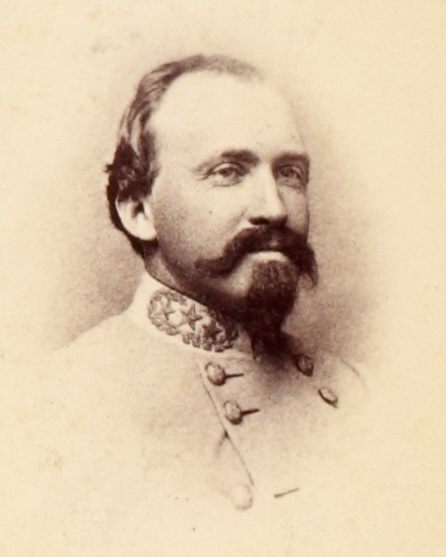
Such is the life of our ancestor Silas Monroe Pipes (grandson of John Pipes Jr. and Michael Harmon). Silas was born in Marion County, Kentucky in 1839, and he appears with his family in the Censuses from 1840, 1850, and 1860. We know from his muster card at the National Archives that in 1862, at the age of 23, he entered the Confederate 7th Kentucky Cavalry as a private (he was joined by his older brother Obediah Brumfield Pipes, and at least two cousins, Bradford Pipes and Elias Pipes). But according to the Adjutant General’s Report (pg 712), Silas was reported “missing in Kentucky” on Feb 13, 1863. He obviously survived, but his whereabouts for the rest of the War are unknown, and he also disappears from all public records for several years after the War. Silas’s brother and cousins were all captured during John Hunt Morgan’s Raid in the summer of 1863, and they spent the remainder of the conflict as prisoners of war at Camp Douglas. But by early 1865, all four of the cousins had returned to their homes in central Kentucky.
We should take a moment to discuss what life in Kentucky was like in the decades leading up to the War Between the States. In a word, it was fractious. If a civil war had not broken out across the entire nation, it almost certainly would have occurred within Kentucky’s borders. Tensions were rising between Kentucky’s various internal factions. The state was divided by sentiments on slavery, from the pro-slavery farmers in the western and central Bluegrass regions, to the residents of Appalachia in the east who had no practical use for enslaved people and were more open to discussions on emancipation. The state was also divided between those who felt loyalty to the Union (and the protection its Constitution offered for individual property rights, which included enslaved people) and those who identified with every part of Southern culture. These fissures, which ran both east-west and north-south, created a political schizophrenia unique to Kentucky, which led to its status as a border state that initially tried to remain neutral when hostilities began in 1861.
It should also be noted that there was a significant minority within the state who were opposed to the “peculiar institution” of slavery. But let’s be clear: very few of them were motivated by any moral arguments, advocating for outright abolition of slavery. Instead, most sought an agreeable compromise that took the form of gradual emancipation, where enslaved people born after a certain date were to be set free on their 18th birthday. This bloc calling for a gradual end to the practice was spurred more by economic concerns, namely that free slave labor exerted downward pressure on wages for all working white people in the state. Altruism played no part in the movement.
The state continued to fracture along these lines, driven by the popularity of the Whig Party throughout the 1840s, and then the ultimate collapse of the Whigs following the Missouri Compromise of 1850, and the subsequent passage of its repeal in the Kansas-Nebraska Act in 1854. By the time Fort Sumter fell in April 1861, tensions within the state that had been simmering came to a full boil. In August, a state legislature that reflected the state’s strong Union sympathies (while the Governor leaned Confederate) took over, and just a month later, Confederate General Leonidas Polk invaded the small town of Columbus, Kentucky, on the Mississippi River. This aggressive action prompted the state legislature to ask for U.S. assistance in repelling the attack, which resulted in General Ulysses S. Grant moving his troops into Paducah, Kentucky, thus ensuring that a state that had intentions of remaining neutral would become a central battlefield for the remainder of the war. Meanwhile, a Confederate shadow government was being formed within the Commonwealth, after delegates from 68 of Kentucky’s 110 counties met at the Russellville Convention and signed an ordinance of secession. Bowling Green, Kentucky, was established as the Confederate capital of the state, while Frankfort remained the Union capital.
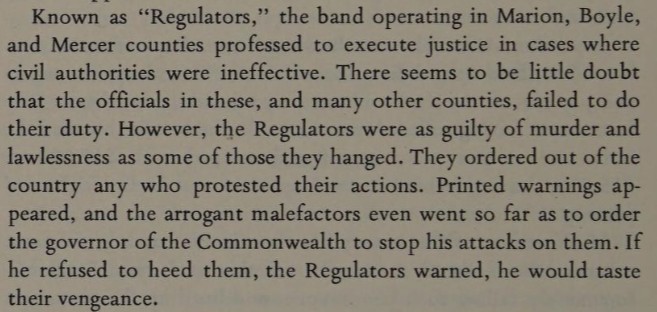
As a result of this extraordinary turmoil, when the Civil War ended in 1865, the conflict in Kentucky was far from over. In fact, one might say that the war continued in Kentucky for decades afterwards. The state had not seceded, and had not joined the Confederacy, so it was not subject to military occupation during Reconstruction (History of Kentucky, Wikipedia). This meant that conflict was actively being suppressed in other southern states, while tensions in Kentucky that were present before the war continued to escalate. With the rise of the Ku Klux Klan, race riots and other violence against freedmen were common throughout the state immediately following the war. Also in parallel with these attacks, the state saw mobs, known as “Regulators,” whose agenda seemed to overlap that of the KKK to a large degree, seek to punish those in their community who had fought for the Union, thus planting the seeds of inter-generational feuds. Some of these feuds were continuations of violent episodes that occurred during the War, between parties that found themselves on opposite sides then, and saw no compelling reason to seek a truce now. Feuds, like the infamous fight between the Hatfields and the McCoys, made Kentucky internationally known and often a dangerous place to live.
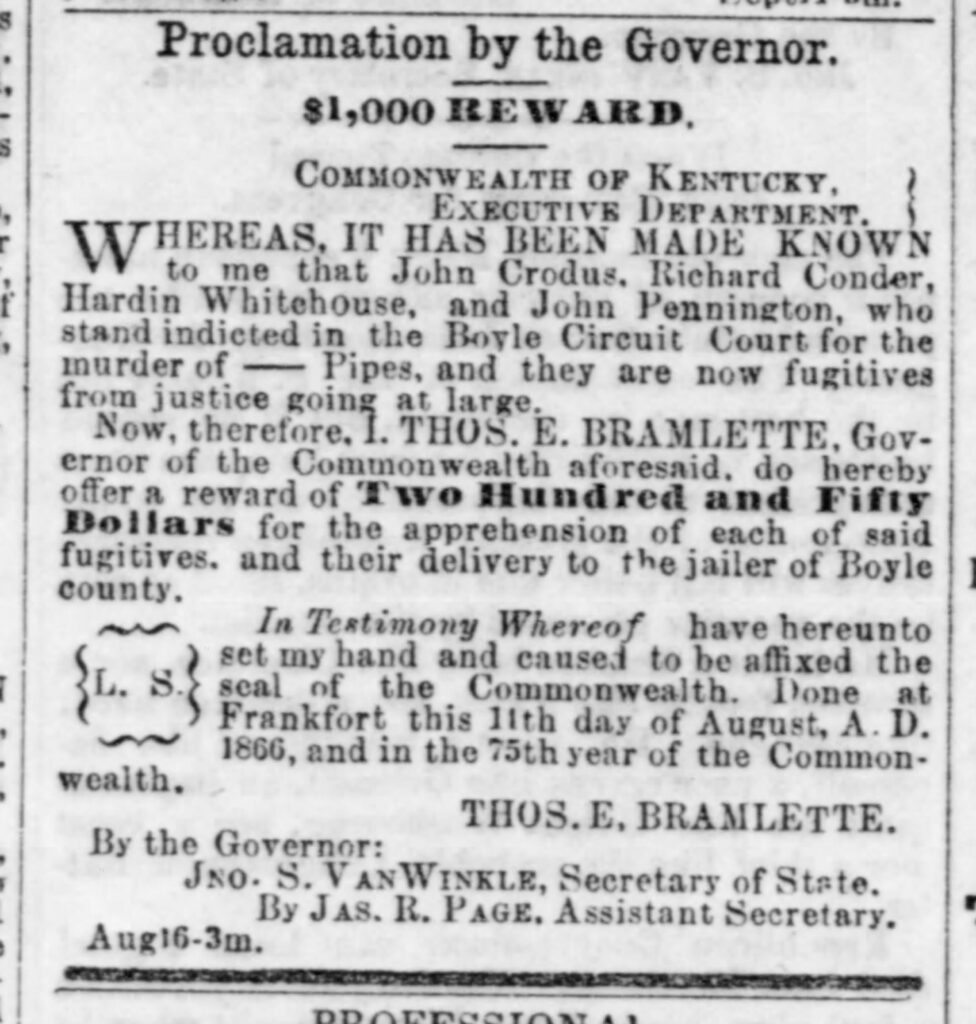
It is against this backdrop that the four cousins of the Pipes family mentioned above tried to return to their ancestral home and some semblance of a normal life. However, in September 1865, Bradford Pipes (also a grandson of our ancestor John Pipes Jr.) was murdered, and later, in February 1866, an indictment was issued for the 7 men thought to be responsible for his death. By August 1866, they had been arrested, but a few days later four of them escaped. Members of the Pipes family, and others from the community, petitioned the governor to offer a reward for their capture. Consequently, the governor issued a proclamation offering a $250 bounty for each of the fugitives. Just a few months later, in February 1867 (now a full year after the indictment), John Pennington was apprehended and killed, with his body brought to Boyle County officials for the reward. Newspaper accounts at the time do not name the person who sought Pennington, but based on Boyle County court records, we know who it was.

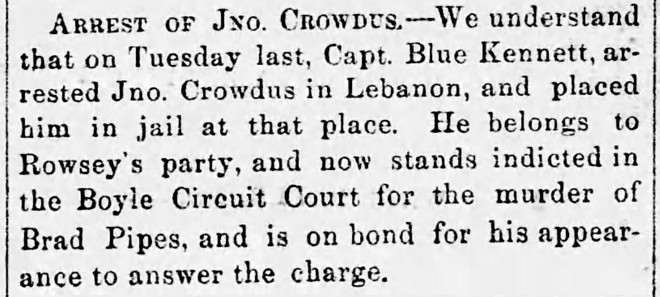
Those same records indicate that the body of Richard Conder was also brought to the jailer of Boyle County (by a different bounty hunter named James Murphy) for the $250 reward. Later that year, in November 1867, John Crowdus was apprehended by Captain Bluford “Blue” Kennett and his militia, and jailed in Lebanon, Kentucky.
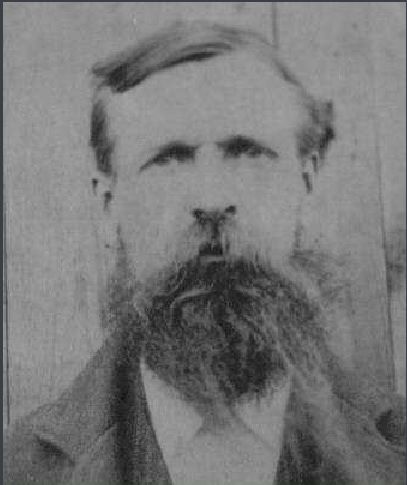
Now we come to the most notorious antagonist in our story. This generation of the Rousey family is infamous and the newspapers of the time are filled with the bloody exploits of almost all of the siblings, but none of them commanded as much press as Smith Rousey himself. He partnered with brothers James Wilson and William Wilson and together they recruited multiple gang members and styled themselves as “anti-Regulators.” But before you make any assumptions about which side they were on, remember the lawless environment of the time. Our understanding of their activities is somewhat limited, based on newspaper coverage at the time, but the press they received was generally unfavorable. Just a few months after the end of the War, Smith Rousey and his entourage were caught in what was described as an ambush in Milledgeville, Kentucky. When he and his accomplices returned fire, it resulted in the shooting of three men, two of whom died at the scene. We are told this was part of a long-simmering conflict between the two parties, but we have no insight into the cause or who might have been “right” and who was “wrong.” Such is the nature of the feud culture that existed at the time. Smith Rousey and/or members of his gang are named in numerous local newspaper accounts of shootings in the area of Mercer, Boyle, and Lincoln Counties.
Then, in October 1867, Governor John Stevenson issues a proclamation offering a $500 bounty for Smith Rousey and William Wilson for the killings of Isaac Hurrigan and Samuel Kinnett (the brother of the militia captain named above). The choice of targets of these so-called anti-regulators was no doubt driven by nothing more than vengeance, but we are certainly left questioning the wisdom of targeting the family of a State Militia leader. Around this same time, Captain Kinnett apprehends Jonathan Crowdus for his involvement in the murder of Bradford Pipes and we learn that Crowdus is considered a member of the Rousey party. It is, therefore, entirely likely that Smith Rousey was somehow involved in that crime as well.
These events follow another proclamation by Governor Stevenson in September 1867 declaring illegal all organizations calling themselves “Regulators” and demanding that they disband. To enforce this, he dispatches his Adjutant General, Frank Wolford, to investigate the wave of violence in Marion County (and surrounding counties), specifically calling out the Rousey Band as a source of the violence. By October of 1867, Wolford recommends and then pursues calling up the State Militia to aid the local authorities in tracking down all of the Regulators. It should be noted at this point, that there is wide consensus that a large number of the men who were called up for this special militia duty were themselves members of the same Regulator posse that they were now charged with hunting down. The irony of this was not lost on Kentucky residents, and, in fact, letters to newspaper editors across the state lamented that taxpayers were now directly funding the violence (with over $17,000 of public money being spent on this effort, by one account).
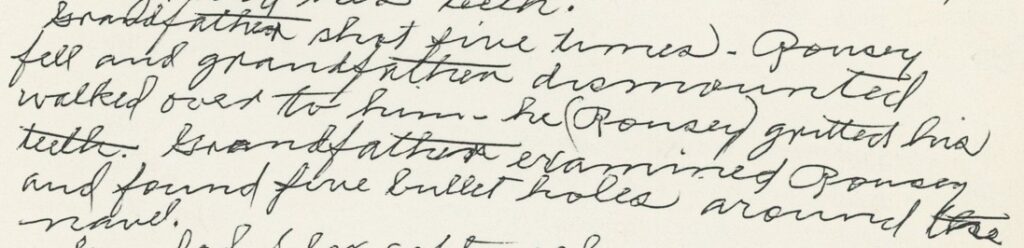
Smith Rousey was shot and killed on Nov 28, 1867. Even though the newspapers did not report it, we now know that Silas Monroe Pipes was a part of Captain Kinnett’s force, as either a member of the militia, or more likely, as a Sheriff’s deputy, and was not only present the day Smith Rousey was killed, but was the man who pulled the trigger. The Louisville Daily Courier reported the following on December 2, 1867:
A company of State militia, under Captain Blue Kinnett, which had been sent to arrest Smith Rousey, came up with him about two miles from south Danville, in Boyle County. Rousey, accompanied by three of his gang, took position on an eminence difficult of approach, and when Kinnett’s command neared his place of concealment, they were fired upon as the first intimation of his presence. A desultory fire ensued, when Kinnett withdrew, as if retreating. Rousey then changed his ground to a more accessible point, when Kinnett returned and made a charge upon Rousey’s position. In the charge Rousey was killed instantly, receiving five wounds.
Passengers on the train yesterday report a fight … in Boyle County … between Capt. Blue Kinnett’s company of State militia and the Wilson and Rousey party. Smith Rousey, who was the recognized leader of this deluded and unfortunate gang, was killed … We are glad to learn that none of Capt. Kinnett’s men were hurt, though one of them had his horse shot under him during the fight.

The two screenshots above, from the Ralph Pipes letter of 1970, clearly show that Silas (who is described as a “crack shot” in the letter) was the man who took down Smith Rousey that day. With details corroborated by the newspaper accounts – details that Ralph Pipes could not have known otherwise. In fact, the name Silas Monroe Pipes does not appear in any Kentucky newspaper during his lifetime. And given what we know about the environment in the Commonwealth, and the fact that he probably would have had several members of the Rousey gang after him, it is certainly understandable why Silas did not want the publicity. We don’t know anything about his motivation in helping pursue Smith Rousey. Was he driven to avenge the murder of his cousin Bradford? Did he do it for the bounty reward? Or did he do it because, as a Sheriff’s deputy, it was simply his duty? We will probably never know his true motivations. But we do know that after he gunned down one of the most notorious criminals of his day, he did not stay in Kentucky for long.
Silas Monroe Pipes and his wife Elizabeth were married in Boyle County in May of 1869. But by the 1870 census, they are both living in DeKalb County, Missouri, near the city of St. Joseph, with their two-month old daughter Margaret. In the 1880 census, they had relocated to Clay County, about 40 miles south, near the small town of Kearney, Missouri, and it is here where Silas, now in his 40s, had begun living a normal life. The local paper, the Liberty Tribune, had started including blurbs about Silas’s comings and goings, just like other local residents. In 1887, he demonstrates his skills as a horseman, showing a 3-year-old trotting mare at the nearby Lawson Fair. In 1890, Silas was appointed as a road overseer by Clay County, Missouri. Accounts from 1894 and 1895, reveal a man involved with his community, purchasing a new home, visiting his friends, and showing horses at the fair. In February 1897, Silas and Elizabeth move from Kearney to be closer to their daughter Margaret and son-in-law James Richard Pipes in the southwest corner of Clay County. By the 1900 Census, Silas and Elizabeth have moved once again, to Bates County, near the small town of Butler, Missouri, and soon after, Margaret and James Richard followed them.
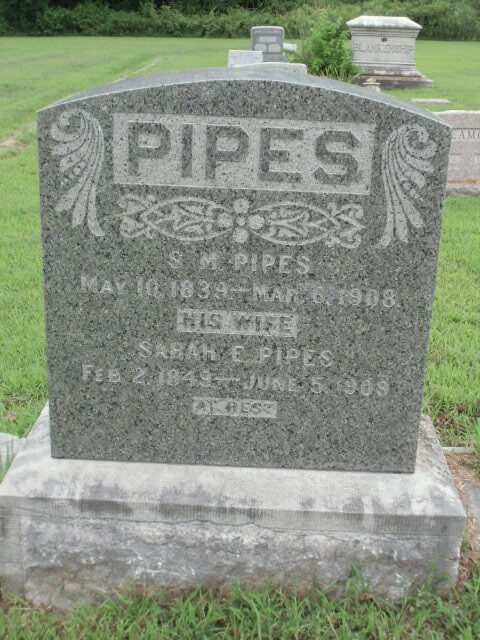
Silas Monroe Pipes passed away in March 1908, and his wife followed him in June 1909. They are both buried at the Altona Cemetery in Bates County.
This post required a lot more investigation than our usual posts, and we wanted to take time to thank our cousin Robert Pipes (over at pipesfamily.com) – Silas Monroe Pipes is our ancestor and Obediah Brumfield Pipes is his. Robert allowed us to borrow a whole box of his research material that he has been collecting for years, and we certainly appreciate his generosity.