
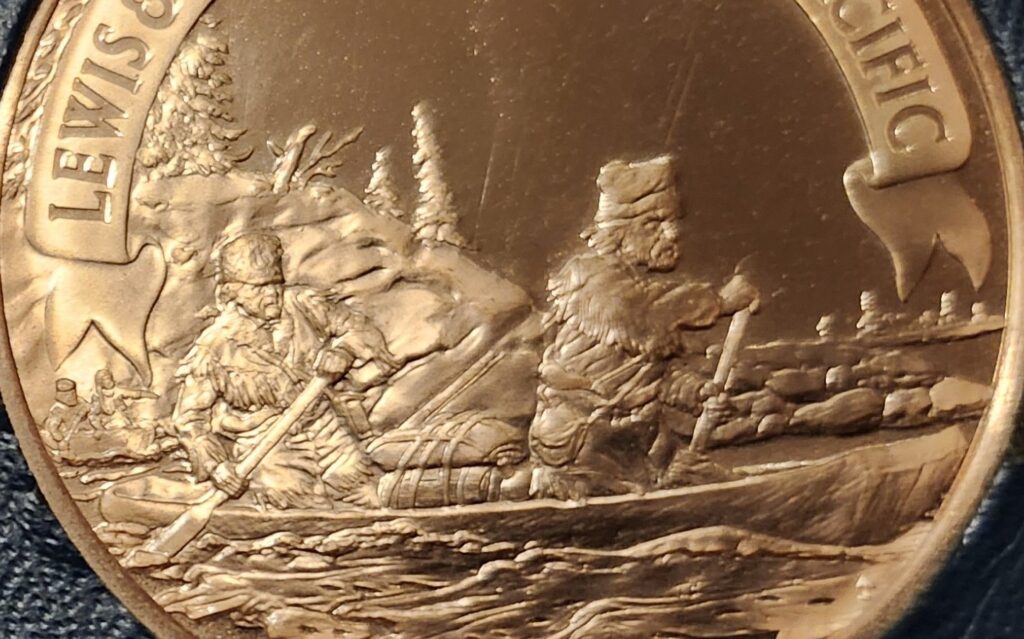

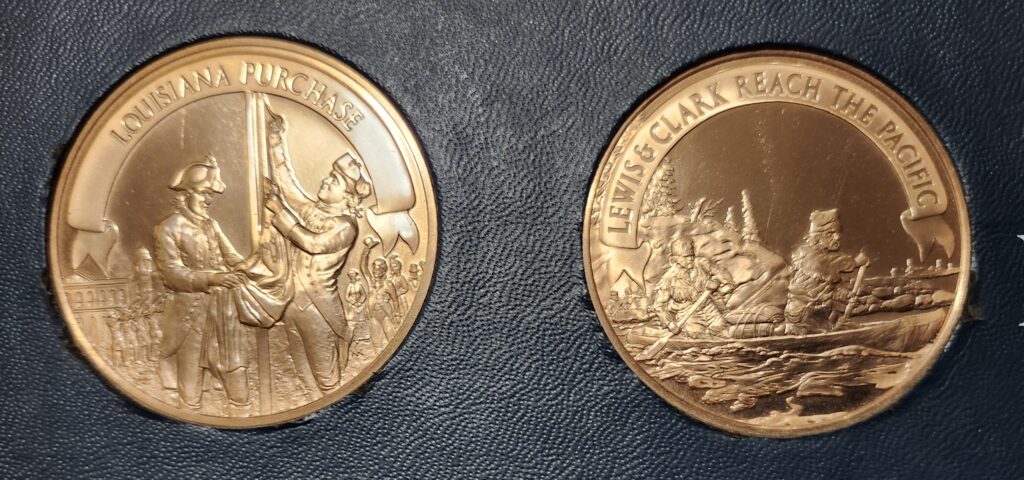
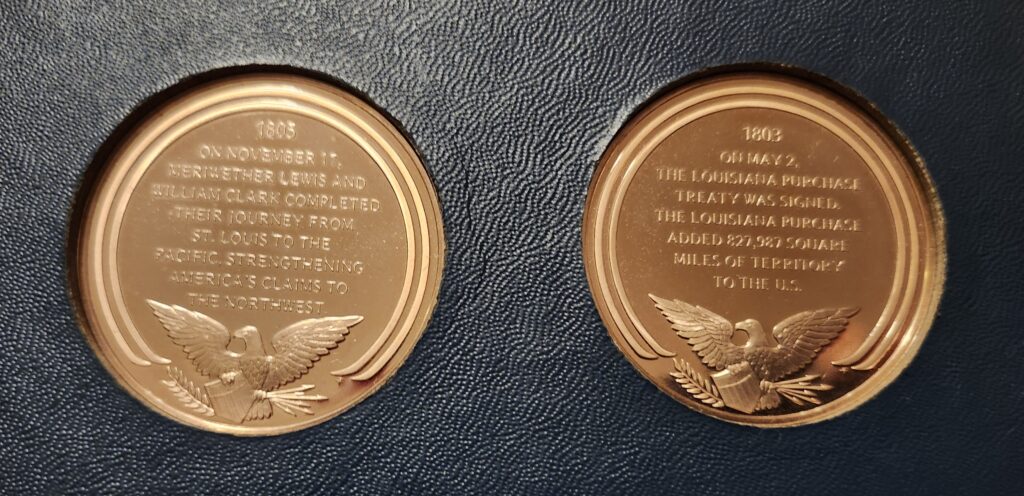
The next two medallions (along with the first of the next pair) cover the period of westward expansion, which was made possible first by the effective end of the Royal Proclamation of 1763, and further accelerated by Lewis and Clark’s Corps of Discovery Expedition (1804-1806). And, of course, once gold was discovered in California (1848), things were never the same.
Thomas Jefferson’s negotiations for the district known as French Louisiana were viewed dimly by his critics who challenged not only the perceived hypocrisy of Jefferson’s justification, but the exorbitant cost as well. Today there is little doubt that he overstepped his authority in buying the land, but it is hard to argue against the long-term benefits of the purchase. However, once he had bought it, Jefferson had to find out exactly what he had bought, and he enlisted the help of his personal secretary and U.S. Army Captain, Meriwether Lewis. The expedition, led by Lewis and his hand-picked partner William Clark, departed from the St. Louis area (what is now St. Charles, Missouri) in 1804 and spent two years exploring the western half of the continent under some of the harshest conditions imaginable.
In the 1840s, one of the biggest proponents of the newly minted concept of Manifest Destiny, Horace Greeley was a strong advocate for westward expansion, and used the newspaper he founded (the New York Tribune) to promote these views. Although he was briefly a congressmen from the state of New York, and a candidate for president in 1872, he is best known for his exhortation in 1865 to “go West, young man, go West and grow up with the country.”