


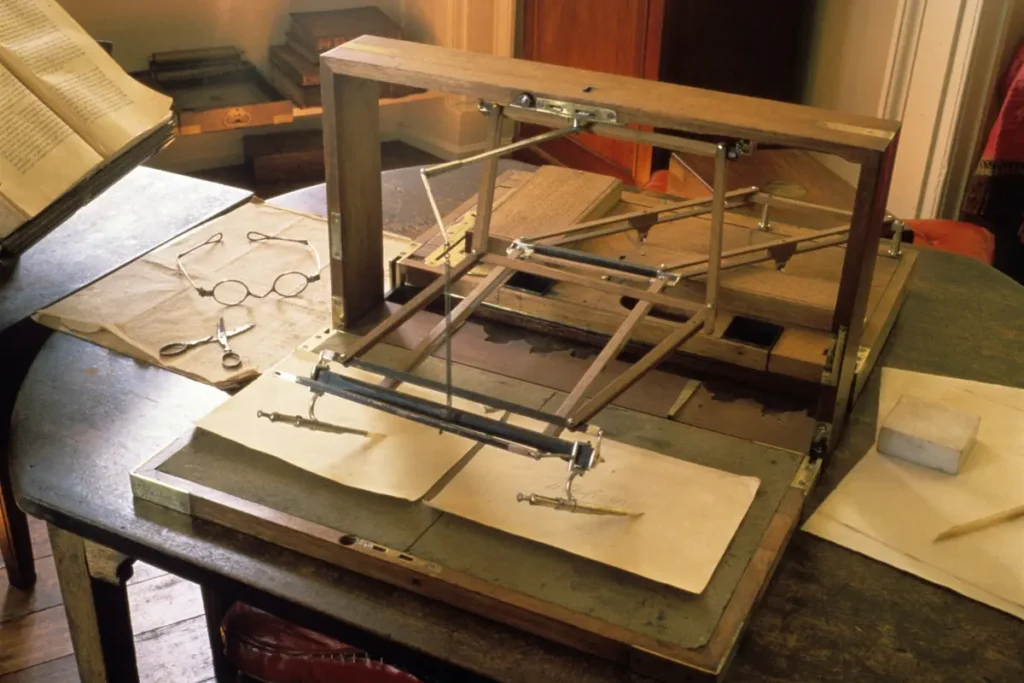
When I was just 18 years old, I visited Monticello and I remember hearing one of the tour guides explain that much of what we know about Thomas Jefferson and his life and accomplishments is from his personal correspondence. Not only did he keep every letter that was ever written to him, but he wrote thousands of letters throughout his lifetime, and he even acquired a device called a polygraph that allowed him to pen a letter and a copy at the same time. Which means, in many cases, we have both sides of conversations that unfolded over years or decades, and that gives us a unique insight into this one individual’s thoughts and philosophies. An individual that ended up being the third President of the United States, and a very influential person in other areas of society. I was inspired by Jefferson’s habit, and I decided to do the same with all of my own correspondence. But I am here to argue that everyone should, especially in today’s digital age, keep this kind of archive.
Blogging is also popular with a lot of people, but it’s the thoughts that we don’t broadcast that are sometimes the most interesting, and have the most bearing on how future historians will record who we are as a people. I have kept a journal (sporadically) throughout my life, and I would advocate that everyone do this as well. Why? There are many benefits that I won’t attempt to enumerate here, but one benefit you may never have considered is to make historians’ jobs easier. Now, you and I may never reach the level of notoriety of a Thomas Jefferson, but that doesn’t mean that there aren’t people who would care to know more about our lives. For instance, your descendants may wish one day that they could get to know you better (even long after you are gone). Their thirst for family history may drive them to devote hours to research, which in all likelihood will yield a sketchy and incomplete story. They might be able to pull together a couple of paragraphs for your obituary, but unless your accomplishments were noteworthy enough to appear in a newspaper somewhere, the sad truth is your great-grandchildren might not even know your name. Additionally, your thoughts and musings that may seem rather insignificant at the time you write them down become part of a collective record about the era in which you live that future historians may reference when researching the past. In every page you write, you are literally recording history.
If you are having trouble hearing these calls from the future to document your life, take a moment to put yourself in their place and consider this: do you know the names and occupations of your great-great-grandparents (all sixteen of them)? If they were still around, what kind of questions would you want to ask them? Would you like to know what life was like 100 years ago? Would you like to know how they met? All of this information was easily available to them, but today it is either locked away in records that are sometimes hard to access, or it is simply gone. Never to be retrieved.
But there is a simple and painless way to solve this problem, and I am here making a public appeal to everyone who lives a life: write things down! Keep a journal, or a scrapbook. Or, if you are feeling really ambitious, write your memoir. At the very least, write on the back of all of those photos in your album, so that people decades from now will know what they are pictures of and why you took them. What I am advocating for is to create your own family archive, and teach your children this behavior as well. If, collectively, we make this a societal norm, there are thousands of future genealogists and historians who will rejoice at our efforts to document our own family histories, and to make a valuable contribution to the history of the entire world. Researching the past is difficult and time-consuming. It would be a lot easier if everyone wrote their own story. And, really, why would you want to allow someone else to tell your story?
I’ll give an example to illustrate my point. Our family archive contains a large collection of letters that my grandmother wrote to my father when he left home for college. He saved every one of her letters, and protected them for decades. Today, those letters are an invaluable resource (to me, anyway) because they provide a window into what my dad’s life was like as he matured from his early twenties and into his forties. Because we only have her letters, the conversation is pretty one-sided, but by reading them I still learn things about his life and the choices he made – things that I never knew before because he never told me those stories or wrote them down. And that is the point: we each have the opportunity to capture something about the life we’ve led. We can choose to tell stories to our kids, and continue a long tradition of oral histories that stretch back millennia, or we can choose to write about our experiences, thereby providing a more permanent record. Or, we could even choose to do both. I’m here to argue, on behalf of your descendants, that you need to care about this, and give it the attention it deserves. You may not feel that you have done anything noteworthy, and may not see the value in documenting your life story. But you cannot possibly know the value of your story to future generations, and the value only grows with age.
Your great-great-grandchildren may one day read your words and find that they resonate in ways you cannot possibly anticipate today. They suddenly feel a connection with their ancestor that anchors them in some way that makes their lives more meaningful. Perhaps that simple anecdote that you consider omitting transforms over time into a moral compass that they carry with them every single day. It’s impossible to predict, but what we can say is that the old adage is true: if you don’t know where you came from, you can’t know where you are going. Let your descendants know where they came from. Tell. Your. Story.



Pingback: Happy Birthday America – The Pipes Family Foundation